
Azulejos are nothing more than thin ceramic tiles, usually square, measuring 13-15 cm. In Portuguese, they are pronounced as azulejżusz, and in Spanish as azulehos. The name azulejos most likely comes from the word azul, which in Spanish and Portuguese means the color blue (and blue became the dominant color of Portuguese azulejos from the end of the 17th century), or from the Arabic word azzulej, meaning small smooth stone – this is how Byzantine mosaics were called.

Azulejos appeared on the Iberian Peninsula as early as the 11th century with the arrival of the Moors, who brought new ceramic manufacturing and decorating technologies such as glazing and luster. These techniques were revolutionary at the time and gained immense popularity in the present-day southern regions of Spain. Centers of ceramic production emerged, among which Malaga was thelargest.
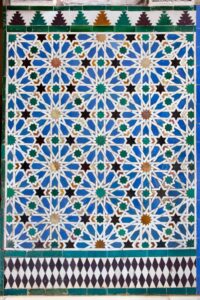
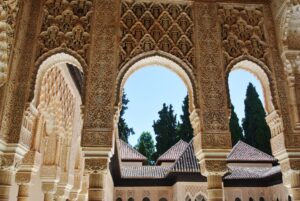
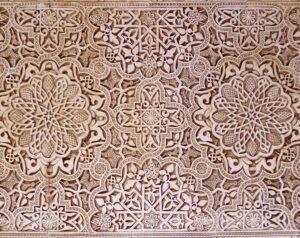
The first azulejo patterns were the so-called Spanish-Moorish patterns (also known as Mudejar azulejo). These were geometric patterns of Islamic origin. A wonderful example of Spanish-Moorish mosaics is the palace in Granada, Spain.
Spanish-Moorish patterns can also be admired in countries of North Africa. These are typical patterns, for example, for handcrafted Moroccan tiles.


In the 14th century, in Spain, azulejos began to be produced on a mass scale. Azulejos reached Portugal after the visit of the Portuguese King Manuel I to Andalusia in 1498. Impressed by the tiles produced in Andalusia, he commissioned the renovation of the palace in Sintra near Lisbon. The Sintra palace was decorated with azulejos imported from Seville and still stands today as a beautiful reminder of Spanish azulejos. It was in the Sintra palace that the tile depicting the so-called armillary sphere first appeared. This symbol is now featured on the flag of Portugal and is an astronomical instrument representing a model of the celestial sphere.
The production techniques of azulejos have evolved over time:
- Azulejo alicatado: Tiles cut into pieces of various shapes with nippers and arranged in mosaics.
- Cuenca/arista: Tiles with protruding thin lines that prevent glazes from mixing.
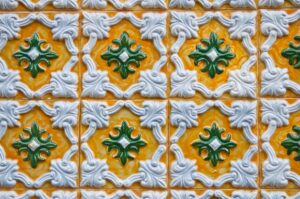
- Azulejo relevado: Typical Portuguese tile with high relief, often featuring vine patterns.

Azulejo relevado - Cuerda seca: Tiles decorated with glazes separated by a thick separator, typically in the form of a black line made of manganese oxide and linseed oil.
- Majolica: Tiles painted with oxides on raw glaze.
Majolica arrived on the Iberian Peninsula in the mid-15th century with the Italian artist Francisco Niculoso. This technique revolutionized the production of azulejo tiles, allowing for the simultaneous painting of several colors on raw glaze.

The themes of azulejo tiles changed over the centuries:
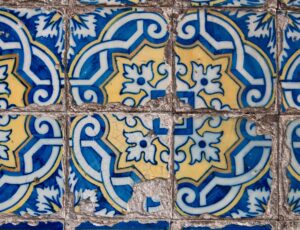
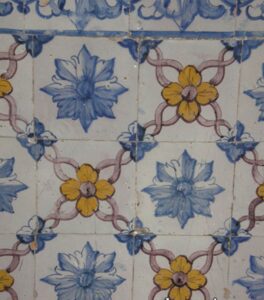
- 16th century – Mannerism and so-called carpet compositions, in a grid pattern, repeatable designs often consisting of two contrasting colors; religious themes – white-blue representations on a yellow background.

Carpet azulejo pattern - 17th century – Religious motifs – representations from the Old and New Testaments; geometric and floral patterns; oriental motifs.
- 17th century – Baroque – so-called grotesques – fantastical scenes and figures; panels depicting vases with flowers.

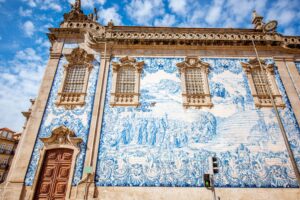
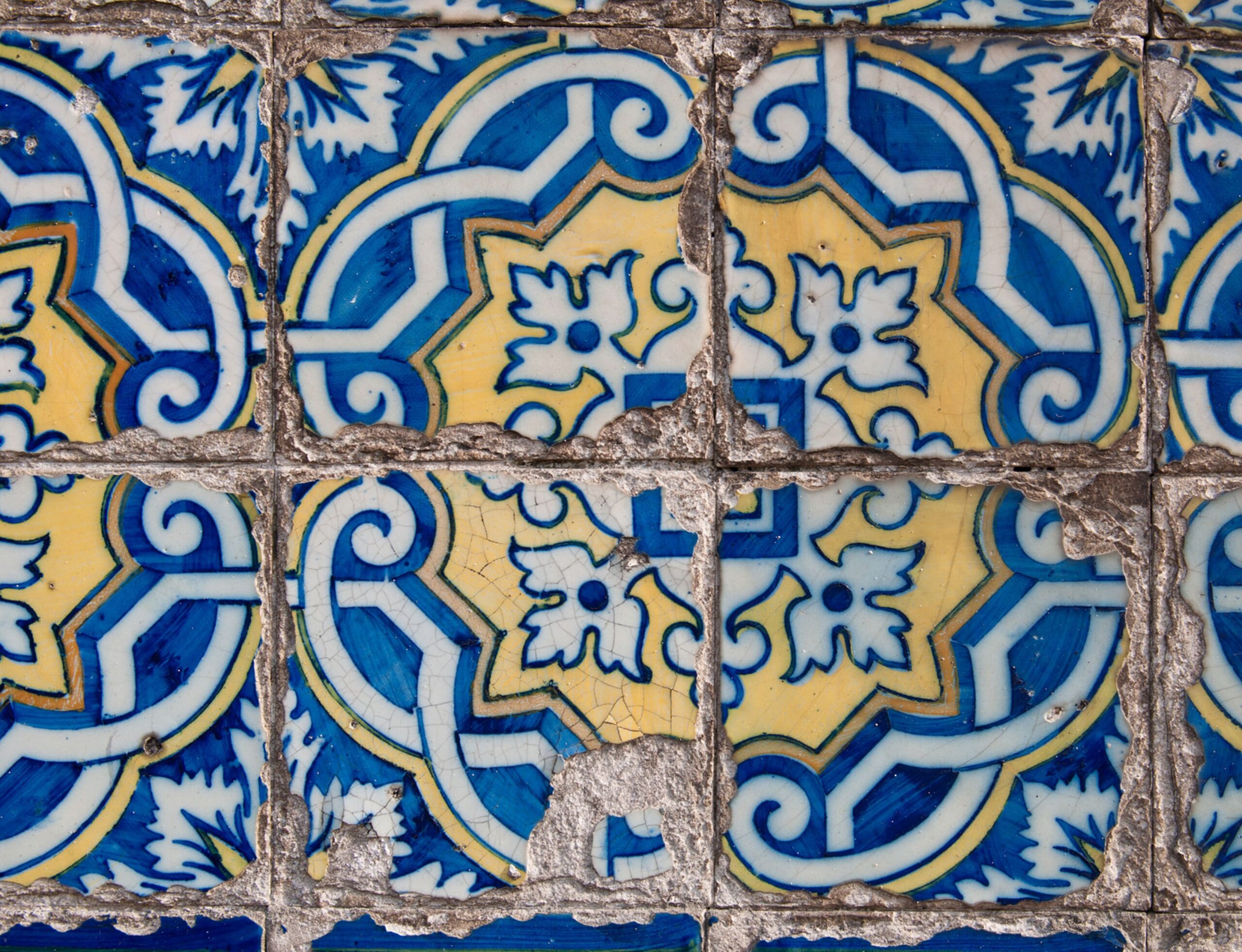
Azulejos covering the church wall - Late 17th/18th century – White-blue color scheme inspired by similarly decorated Chinese porcelain imported by sea to Europe; however, Portuguese tiles are characterized by monumental panels covering entire walls; religious, courtly, military themes.
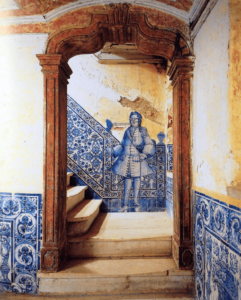
- 18th century/Rococo – white-blue representations surrounded by a colorful frame; the so-called “figura de convite” appears, which is a welcoming figure in a 1-1 scale.

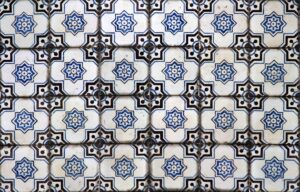
- 18th century – after the earthquake in Lisbon in 1755 – Pombaline patterns dominate; thename comes from the Marquis of Pombal, who managed the reconstruction of Lisbon; due to the need for rapid city reconstruction, these patterns are simple, repeatable, less ornate, and easy to lay; panels of patron saints above the doors of houses also appear to protect residents from disasters.

Pombaline azulejos
- End of the 18th century – Neoclassicism – lighter patterns; birds, garlands, leaf and flower frames appear.
- Second half of the 19th/early 20th century – the opening of factories led to more mass production of azulejos and resulted in the decoration of entire building facades with tiles.
- 20th/21st century – abstract patterns.
You’ll find hand-painted azulejo tiles in my store. I paint them with majolica technique, just like it was done in the 16th century:)
You’ll find a piece of Portugal on tiles here:


This Post Has 2 Comments
Hi, I do believe this is a great website. I stumbledupon it 😉 I may revisit once again since I
book marked it. Money and freedom is the greatest way to change, may you be rich and continue to help others.
Thank you! I hope you will revist my website plenty of times:)